

Imma Perfetto
Cosmos science journalist
Towering stalactites hang from ceilings and mighty stalagmites rise from the floors of ancient caves around the world, much like the teeth of great cavernous mouths.
These natural pillars form from water which filters through the ground, drips into caves and evaporates away to deposit calcite (calcium carbonate) and other minerals layer by layer.
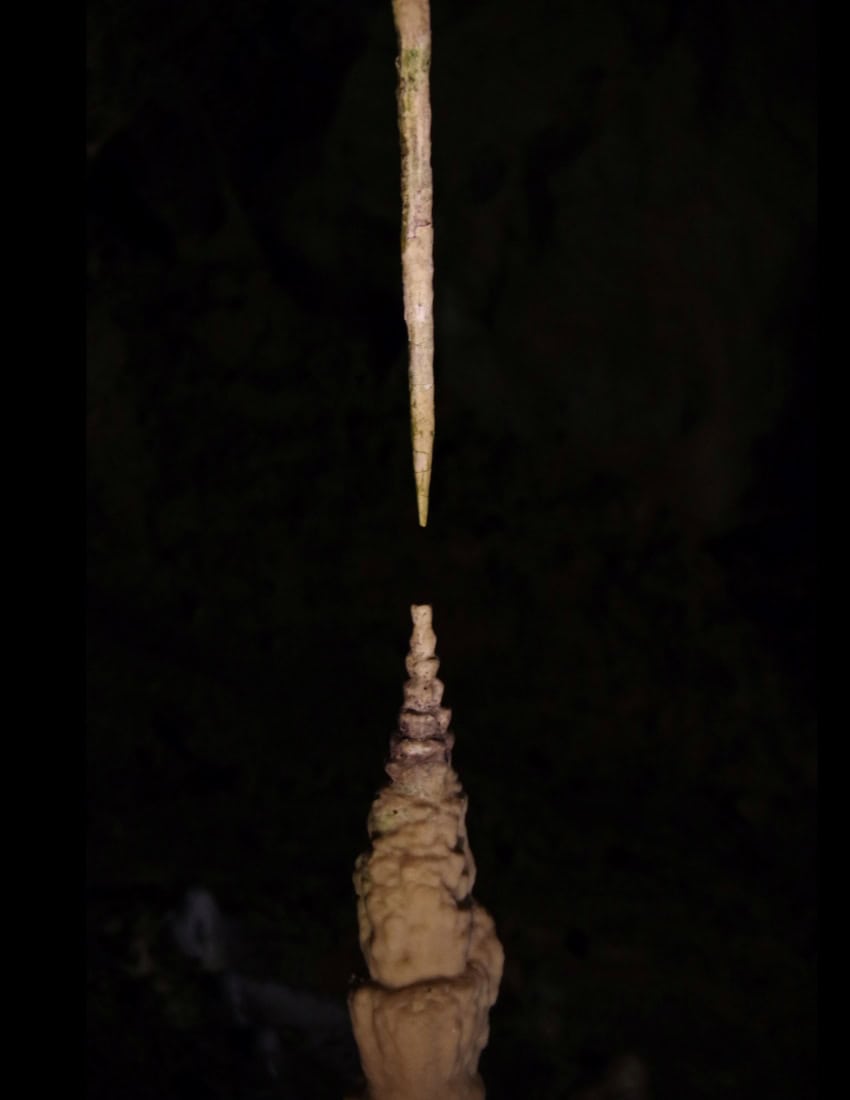
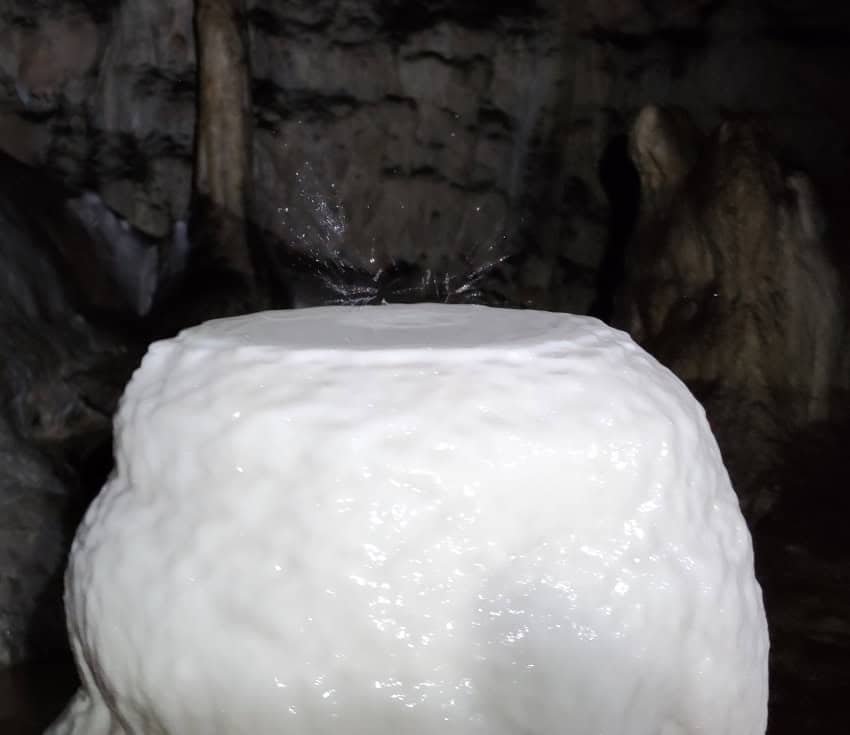
Stalagmites grow from just centimetres tall to metres in height over long periods of time, some forming slender cones, others massive columns or flat-topped pedestals.
Now, researchers have solved the mathematics of how stalagmites grow, with implications for how scientists interpret records of ancient climates trapped within the layers of stone.
The mathematical model predicts how an ideal stalagmite grows when conditions in a cave remain the same over time.
“It turns out that the rich diversity of stalagmite shapes can be explained by one simple parameter,” says Piotr Szymczak of the University of Warsaw, Poland.
“This is a rare case where the beauty we see in nature corresponds directly to a clean mathematical law.”
This factor, the ‘Damköhler number’, represents a balance between the flow of water and the rate of mineral precipitation.
According to the model, column-like stalagmites form when water drips from above in a concentrated and steady way. Whereas drips which fall in a spread-out pattern produce flat-topped stalagmites.

Sharp, pointed cones arise when water flows quickly or drips directly onto the stalagmite without variation.
“When we compared our analytic solutions with real cave samples, the match was remarkable,” says coauthor Matej Lipar, from the Research Centre of the Slovenian Academy of Sciences and Arts.
“It shows that even under natural, messy conditions, the underlying geometry is there.”
Scientists use the changing ratios of certain elemental isotopes trapped inside a stalagmite’s layers of stone to reconstruct rainfall and temperature records over deep time.
The new model indicates that flat-topped stalagmites record these signals differently from columnar or conical ones.
“Stalagmites are natural climate archives, but we now see that their geometry leaves its own imprint on the isotopic record,” says coauthor Anthony Ladd, from the University of Florida in the US.
“Recognising this effect will allow us to extract more reliable information about past climates.”
The new research is published in PNAS.