

Imma Perfetto
Cosmos science journalist

A commercially available technology could help protect vulnerable older people against seasonal respiratory viral outbreaks and future pandemics as a useful addition to existing infection control measures, according to a randomised clinical trial.
Findings published in JAMA Internal Medicine show that germicidal ultraviolet (GUV) appliances reduced overall viral respiratory infections in 4 aged care facilities by more than 12% compared to normal.
The study explored new ways to protect aged care residents from harmful outbreaks of viruses without disrupting their day-to-day activities.
“Outbreaks of viruses such as COVID-19 are absolutely devasting for older people, significantly increasing the risks of hospitalisation and death,” says senior author Professor Geraint Rogers from Australia’s Flinders University.
GUV appliances can be mounted to ceilings and walls or fitted to ventilated AC systems.
The appliances produce light in the ultraviolet-C range (100 to 280nm wavelength) to deactivate viruses, bacteria and funguses in the air. The UV light alters the micro-organism’s DNA, rendering it unable to reproduce.
The technology is already used as a powerful disinfectant in various settings, such as commercial food processing and laboratories. But according to the authors of this study, GUV appliances are yet to be examined in health care settings.
“Some of the key advantages of germicidal ultraviolet air-treatment appliances are that they are easily installed into existing facilities and cost effective to use,” says lead author Dr Andrew Shoubridge from Flinders and the South Australian Health and Medical Research Institute (SAHMRI).
“When used in conjunction with existing infection control measures, they could be transformative in reducing rates of seasonal respiratory viral infections and protecting residential aged care facilities against emerging pathogens.
“We designed a randomised clinical trial to compare the same environments with and without the appliances tracking infection rates over 2 years.”

GUV appliances were installed in 2 equally sized common spaces with roughly 40 residents per zone. One was continuously switched on (intervention) while the other was turned off (control) for the 6-week period.
Then they swapped for the next 6 weeks and this was repeated for 7 cycles.
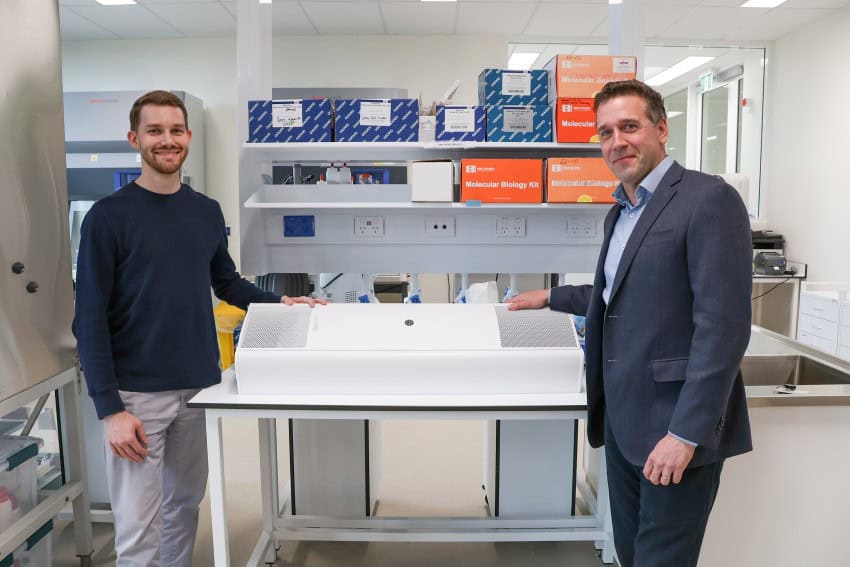
The study found that GUV appliances did not result in a significant difference in the incidence rate of influenza infections per zone per cycle. When modelled across all cycles of the study, however, Shoubridge says “they did help reduce overall numbers of respiratory infections by 12.2%, or roughly 0.3 fewer cases per week”.
“This difference in findings”, the authors write, “likely reflects the random timing of infections, variations in infection rates between cycles, and external environmental factors.
“Our study estimated the causal effect of the intervention to be an approximately 9% reduction in infections. When applied to the acute respiratory infection (ARI) rate in the control arm, such a reduction equates to 92 fewer ARIs per 1,000 residents annually.
“While falling short of the 20% benchmark that is often considered a clinically meaningful change for an individual, such a reduction could translate to a very meaningful effect from a public health perspective for which the aggregate benefit of even small individual improvements becomes substantial.”
“This means GUV technology could make a noticeable difference in protecting people in aged care facilities, especially when we consider there are 250,000 Australians currently living in them,” explain Shoubridge.
The authors say that further studies are needed to understand how the type and deployment pattern of GUV appliances influences their effect.