

Imma Perfetto
Cosmos science journalist
One of the greatest challenges facing this century is to meet global energy demands while transitioning from fossil fuels to sources of clean energy.
Solid-oxide fuel cells (SOFCs), electrochemical devices which convert chemical fuel into electricity, are one approach which may help. SOFCs can be fuelled by green hydrogen produced through electrolysis of water using renewable energy.
But while SOFCs are highly efficient, stable, and have long lifespans, they suffer from a major drawback. To run efficiently, they must operate at extremely high temperatures (700-800°C) which necessitates costly heat-resistant materials and long start-up times.
As a result, the technology is still in the early stages of commercialisation.
“Bringing the working temperature down to 300°C would slash material costs and open the door to consumer-level systems,” says Professor Yoshihiro Yamazaki from Kyushu University’s Platform of Inter-/Transdisciplinary Energy Research, Japan.
Yamazaki is senior author of a new study in the journal Nature Materials which presents a new SOFC designed to operate at this sweet spot.
Inside a SOFC, the fuel continuously enters the negatively charged electrode (anode) where it oxidises. This process releases electrons which migrate via an external circuit to the positively charged electrode (cathode), producing an electric current.
When the SOFC is fuelled by hydrogen, this leaves behind positively charged hydrogen ions (protons).
Oxygen at the cathode undergoes reduction (receives electrons) and forms negatively charged oxygen ions which pass through a solid oxide or ceramic electrolyte to reach the anode.
There a chemical reaction occurs to produce water (H2O) as a byproduct.

The problem, according to Yamazaki, is “no known ceramic could carry enough protons that fast at such ‘warm’ conditions [300°C]”.
“So, we set out to break that bottleneck,” says Yamazaki.
“Adding chemical dopants can increase the number of mobile protons passing through an electrolyte, but it usually clogs the crystal lattice, slowing the protons down. We looked for oxide crystals that could host many protons and let them move freely – a balance that our new study finally struck.”
The team found that doping barium stannate (BaSnO3) and barium titanate (BaTiO3) with high concentrations of scandium (Sc) produced an electrolyte with a proton conductivity at 300°C comparable to that of conventional SOFC electrolytes at 700-800°C.
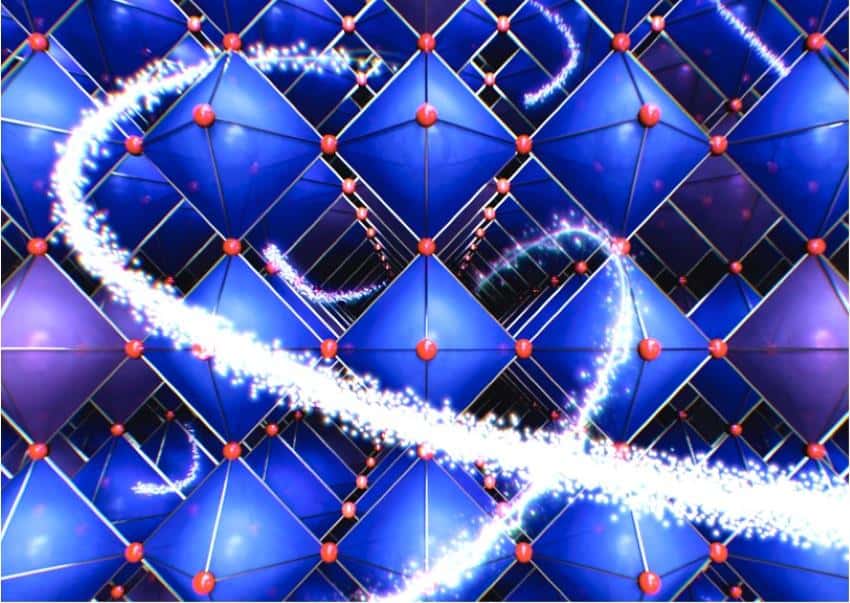
“Structural analysis and molecular dynamics simulations revealed that the Sc atoms link their surrounding oxygens to form a ‘ScO₆ highway,’ along which protons travel with an unusually low migration barrier. This pathway is both wide and softly vibrating, which prevents the proton-trapping that normally plagues heavily doped oxides,” explains Yamazaki.
“Lattice-dynamics data further revealed that BaSnO₃ and BaTiO₃ are intrinsically ‘softer’ than conventional SOFC materials, letting them absorb far more Sc than previously assumed.
“Our work transforms a long-standing scientific paradox into a practical solution, bringing affordable hydrogen power closer to everyday life.
“Beyond fuel cells, the same principle can be applied to other technologies, such as low temperature electrolysers, hydrogen pumps, and reactors that convert CO₂ into valuable chemicals, thereby multiplying the impact of decarbonisation.”