

Imma Perfetto
Cosmos science journalist
Soft, breathable and skin-conformable electronic textiles could one day provide wearable device users with the ability to monitor their health and physical activity with unparalleled ease.
Stable power outputs are needed to support these kinds of textile-based electronic components. But human bodies are dynamic – they bend, twist and stretch, especially during exercise. Clothing-integrated batteries must also be able to do so without losing their effectiveness.
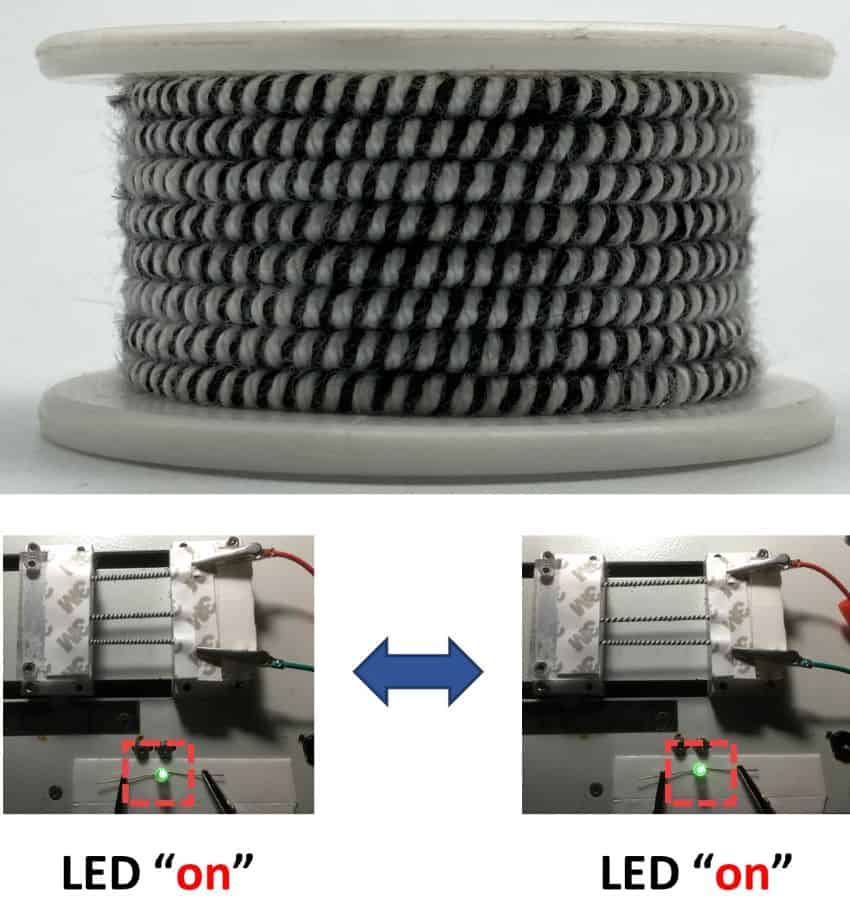
Materials and energy scientists in China have now designed a stretchable yarn battery which can use human sweat as an electrolyte to generate power under varying strain.
Crucially, the technology’s voltage output was shown to remain stable after 2,000 cycles of stretching, 20 cycles in a commercial washing machine and storage in ambient conditions for 7 months.
Zhisong Lu, a professor at Southwest University, China, says the stretchable sweat-activated yarn battery “can be scaled up to meter-scale fabrication using a self-designed wrapping machine and seamlessly integrated into electronic textiles through traditional techniques, such as weaving, knitting, sewing, and stitching”.
Lu’s team integrated the yarn battery into a headband and t-shirt which could power LEDs and a pedometer, respectively, after absorbing sweat from trial volunteers.
“The on-skin tests show that stretchable sweat-activated yarn batteries can be integrated into textiles that come into contact with the skin as a safe energy source,” says Lu.
The yarn battery’s voltage output varied by less than 0.5% under dynamic stretching due to its clever design.
“An elastic yarn was selected as the stretchable core,” write Lu and co-authors in a paper presenting the technology in the journal Wearable Electronics.

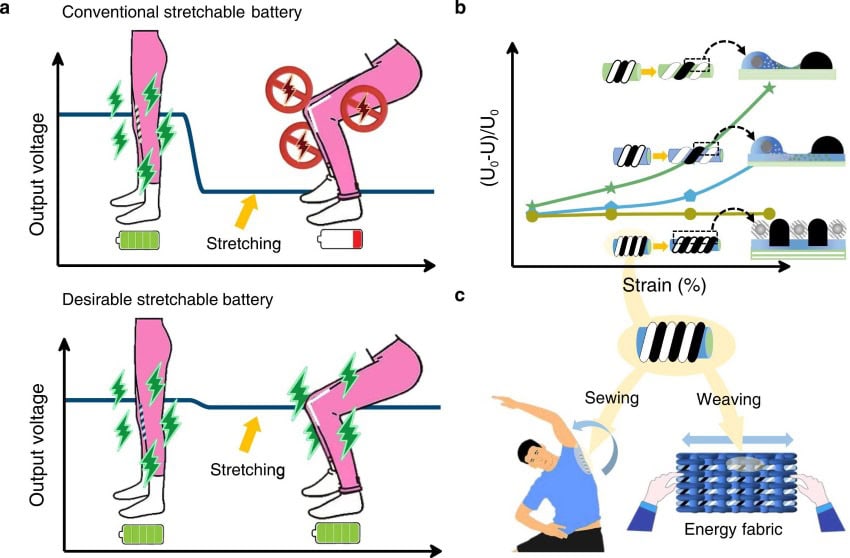
“A cotton fibre-wrapped zinc wire and a carbon yarn were wrapped parallel along the core surface to form the sheath layer.
“The cotton fibres rapidly channel sweat to connect the adjacent zinc wire (anode) and carbon yarn (cathode), thus activating the battery.” They also acted as a separator to prevent the anode and cathode from coming into direct contact and short-circuiting.
“The ring-like configuration of the surface-wrapped electrodes allows them to stretch and recover along with the elastic core,” the authors write.
The electrode coils were wrapped densely around the elastic fibre core to maintain connectivity by minimising “the separation distance between adjacent electrodes during stretching”. The core was also wrapped with ‘hydrophilic’ (water attracting) polyester fibres which held on to the sweat to allow ions to better migrate between the electrodes.
“Our goal was to create a stretchable yarn battery with ultra-stable power output under varying strains,” says Lu.
“The battery bridges the gap between stretchability and output stability, a significant long-standing challenge for stretchable power sources.”
The authors note that the technology’s performance may be influenced by “daily use, environmental conditions and variations in sweat composition” and that “these factors warrant further investigation in future studies”.