

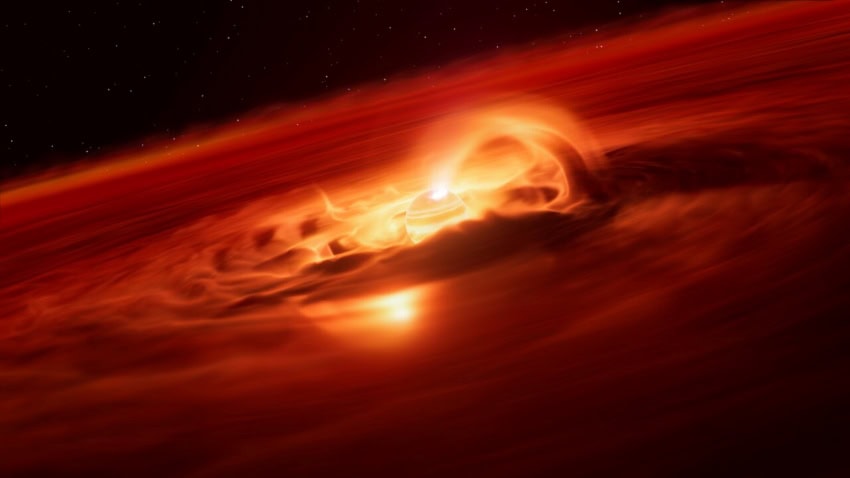
Astronomers have witnessed a planet 620 light-years away eat up nearby gas and dust at a rate of 6 billion tonnes a second, the fastest growth rate ever recorded for a rogue planet.
The planet, Cha 1107-7626, has a mass 5 to 10 times that of Jupiter. These observations shed light on how rogue planets, which don’t orbit a star, grow and behave during their early formation.
Planets are formed through a process called accretion, where dust, gas and other particles are gravitationally attracted into a disk which eventually clumps together into a planet. The dramatic rate at which this planet is accreting suggests that some rogue planets may form more like stars than typical star-orbiting planets.
“The origin of rogue planets remains an open question,” says Aleks Scholz from Scotland’s University of St Andrews and co-author of a study presenting the new findings in the Astrophysical Journal Letters.
“Are they the lowest-mass objects formed like stars, or giant planets ejected from their birth systems?”
When the researchers compared the rogue planet’s accretion rate over months, they found it wasn’t accreting at a steady rate. In one of the planet’s ‘growth spurts’ it reached an accretion rate of 6 billion tonnes per second which was 8 times faster than the rate the team had measured a few months before.
“We’ve caught this newborn rogue planet in the act of gobbling up stuff at a furious pace,” says co-author Ray Jayawardhana from Johns Hopkins University in the US.
“We’re struck by quite how much the infancy of free-floating planetary-mass objects resembles that of stars like the Sun.”
Water vapor was not detected on the planet prior to accretion, but was present during the burst which suggests the chemistry of the planet changed.
While previous researchers have witnessed this phenomenon occurring in stars, it has never been seen in planets.

“The idea that a planetary object can behave like a star is awe-inspiring and invites us to wonder what worlds beyond our own could be like during their nascent stages,” says Amelia Bayo, a co-author of the study from the European Southern Observatory (ESO).
The rogue planet also seems to possess a strong magnetic field which the authors believe may have played a role in its growth. Magnetic activity like this has only been previously observed in stars.
“This discovery blurs the line between stars and planets and gives us a sneak peek into the earliest formation periods of rogue planets,” says Belinda Damian, an astronomer at the University of St Andrews.
The observations of Cha 1107-7626 were made with the ESO’s Very Large Telescope. The team observed changes in the accretion across 3 periods in April, May and late June 2025. They then performed follow-up observations across August using the James Webb Telescope.
“This is the strongest accretion episode ever recorded for a planetary-mass object,” says Víctor Almendros-Abad, the lead author of the study from the Palermo Astronomical Observatory of the National Institute for Astrophysics in Italy.
“People may think of planets as quiet and stable worlds, but with this discovery we see that planetary-mass objects freely floating in space can be exciting places.”
The ESO’s upcoming Extremely Large Telescope should make detecting more of these free-floating planets easier.
“Our new findings underscore that similarity and imply that some objects comparable to giant planets form the way stars do, from contracting clouds of gas and dust accompanied by disks of their own, and they go through growth episodes just like newborn stars,” says Jayawardhana.
“Their infancy appears to be much more tumultuous than we had realised.”