

Imma Perfetto
Cosmos science journalist
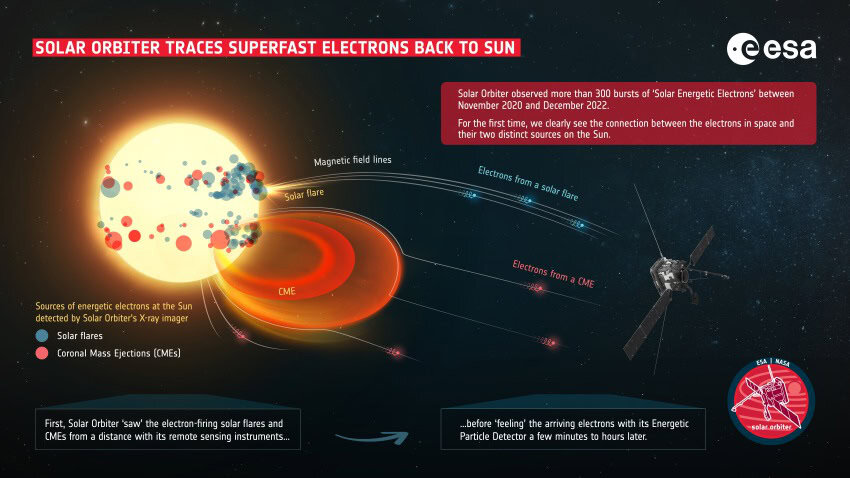
A European Space Agency-led mission has used the Solar Orbiter to track where super energetic electrons come from in the Sun, tracing their origins to 2 events.
The findings will help scientists to conduct more accurate space weather forecasts to keep spacecrafts undamaged and operational.
“Knowledge such as this from Solar Orbiter will help protect other spacecraft in the future, by letting us better understand the energetic particles from the Sun that threaten our astronauts and satellites,” says Daniel Müller, an ESA Project Scientist for Solar Orbiter.
The Sun accelerates electrons to nearly the speed of light and then launches them into space, creating Solar Energetic Electrons (SEEs). There are 2 kinds of SEEs dashing around the solar system.
One type is created during intense solar flares – bursts of high-energy radiation from the Sun’s surface. The other kind comes from coronal mass ejections (CMEs) which are larger explosions of hot plasma and magnetic fields from the Sun’s atmosphere (corona).
CMEs tend to be higher energy events, meaning they also carry higher energy particles which can damage spacecraft, making it important to understand how these particles travel.
“We see a clear split between ‘impulsive’ particle events, where these energetic electrons speed off the Sun’s surface in bursts via solar flares, and ‘gradual’ ones associated with more extended CMEs, which release a broader swell of particles over longer periods of time,” says Alexander Warmuth, lead author of the study from the Leibniz Institute for Astrophysics Potsdam, Germany.
While scientists knew there were 2 types of SEEs, the research published in Astronomy & Astrophysics revealed more in-depth information about how solar events form and fling them off the Sun.
“We were only able to identify and understand these 2 groups by observing hundreds of events at different distances from the Sun with multiple instruments – something that only Solar Orbiter can do,” says Warmuth.
The Solar Orbiter was launched in 2020 as a joint mission between the ESA and NASA to take close-up images of the Sun and measure solar winds.
“During its first 5 years in space, Solar Orbiter has observed a wealth of Solar Energetic Electron events. As a result, we’ve been able to perform detailed analyses and assemble a unique database for the worldwide community to explore,” says Müller.
The Solar Orbiter comes as close as 42 million km from the surface, making it one of the Sun’s closest satellites.

“By going so close to our star, we could measure the particles in a ‘pristine’ early state and thus accurately determine the time and place they started at the Sun,” says Warmuth.
One unanswered question the research addressed was why there always seems to be a lag between when researchers spot a flare or CME and the eventual release of electrons.
Previous observations have noted that the electron release can take hours.
“It turns out that this is at least partly related to how the electrons travel through space – it could be a lag in release, but also a lag in detection,” says Laura Rodríguez-García, ESA Research Fellow and co-author of the study.
“The electrons encounter turbulence, get scattered in different directions, and so on, so we don’t spot them immediately. These effects build up as you move further from the Sun.”
While you may think that there is just empty space between the Sun and the Earth, this isn’t the case. Charged particles constantly stream from the Sun, pulling its magnetic field along for the ride in a solar wind which can disrupt how SEEs move.
The ESA plans to launch the Smile mission next year to continue to measure solar winds and provide even more details on how energetic electrons interact with the Sun’s magnetic field.
“Thanks to Solar Orbiter, we’re getting to know our star better than ever,” says Müller.
“The research is a really great example of the power of collaboration – it was only possible due to the combined expertise and teamwork of European scientists, instrument teams from across ESA Member States, and colleagues from the US.”