

Evrim Yazgin
Cosmos science journalist
A new technique measuring magnetic fields of some of the largest structures in the universe could be the key to identifying the elusive dark matter particles.
But the story begins with something tiny – a theoretical fundamental particle called an axion.
Axions were first proposed by theoretical physicists in the late 1970s to explain subatomic interactions which don’t follow the rules set out in the standard model of particle physics. They may also hold the key to dark matter.
In recent decades, experiments looking for axion dark matter in particle accelerators have popped up. Other experiments – including the CERN Axion Dark Matter eXperiment (ADMX) and CERN Axion Solar Telescope (CAST) – have turned to space to find axions, rather than producing them on Earth.
A new method described in a paper published in Nature Astronomy, takes this to the extreme.
The physicists behind this research have turned to the largest structures in the cosmos: galaxy clusters. These clusters of galaxies can be a quadrillion (1 with 15 zeroes after it) times heavier than our Sun.
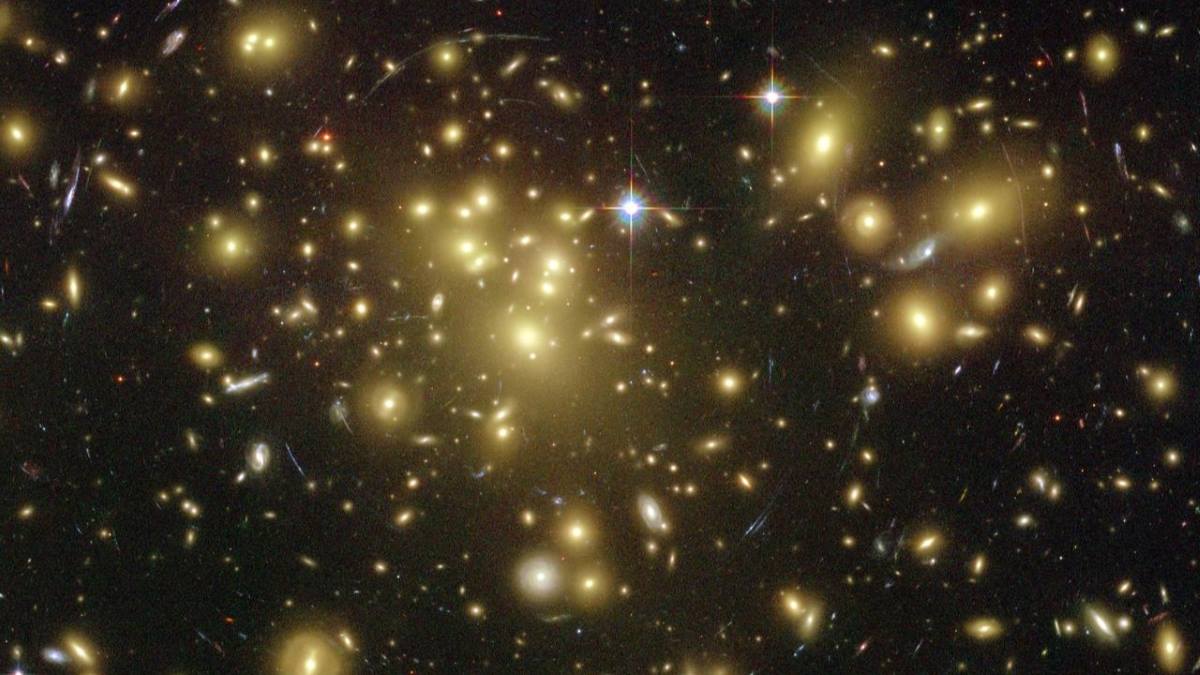
The physicists describe a phenomenon which begins with electromagnetic radiation emitted from the cores of distant, bright galaxies with supermassive black holes at their centre. When this radiation passes through the vast magnetic fields generated by galaxy clusters, some of it could theoretically transform into axions.
Axion creation in these magnetic fields would leave tiny, faint fluctuations in the data.

“We looked at these black holes through clusters of galaxies,” says senior author Oleg Ruchayskiy, an associate professor at the Niels Bohr Institute of the University of Copenhagen, Denmark.
“Galaxy clusters are among the largest structures in the universe and reservoirs of enormous, widespread magnetic fields. They act as a sort of prism through which some of the gamma rays in theory would turn into axions.”
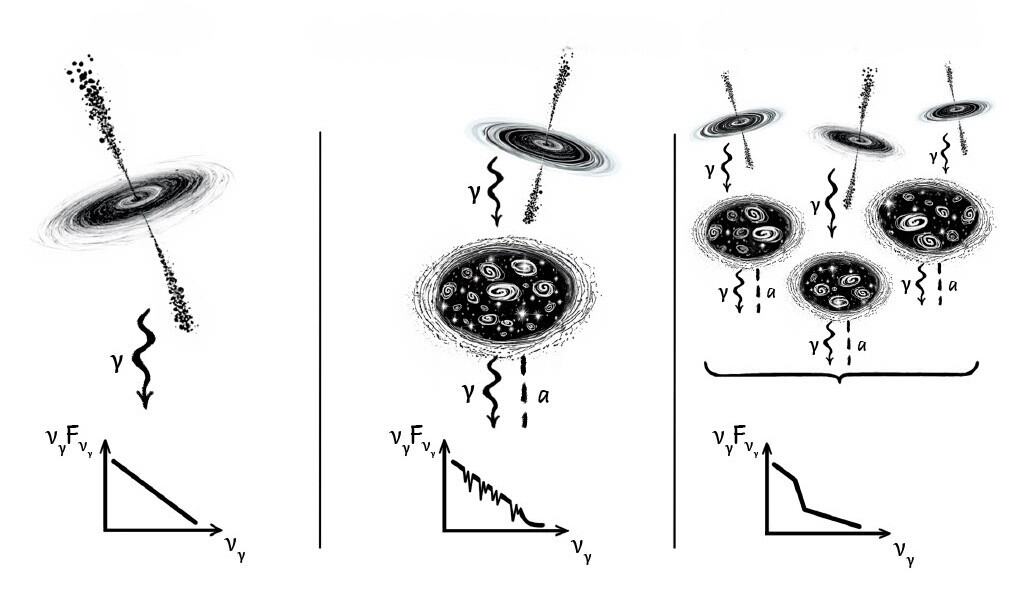
“Normally, the signal from such particles is unpredictable and appears as random noise,” Ruchayskiy adds. “But we realised that by combining data from many different sources, we had transformed all that noise into a clear, recognisable pattern.”
“It shows up like a unique step-like pattern that shows what this conversion could look like. We only see it as a hint of a signal in our data, but it is still very tantalising and exciting. You could call it a cosmic whisper, now loud enough to hear,” Ruchayskiy explains.
The pattern is not definitive proof of the existence of axions but it could be a step toward their discovery and answering the question of the nature of dark matter.
“This method has greatly increased what we know about axions. It essentially enabled us to map a large area that we know does not contain the axion, which narrows down the space where it can be found,” says leading author Lidiia Zadorozhna, a Marie Curie fellow at the Niels Bohr Institute.
“We are so excited, because it is not a one-time advancement. This method allows us to go beyond previous experimental limits and has opened a new path to studying these elusive particles. The technique can be repeated by us, by other groups, across a broad range of masses and energies. That way we can add more pieces to the puzzle of explaining dark matter,” Zadorozhna adds.