

Evrim Yazgin
Cosmos science journalist
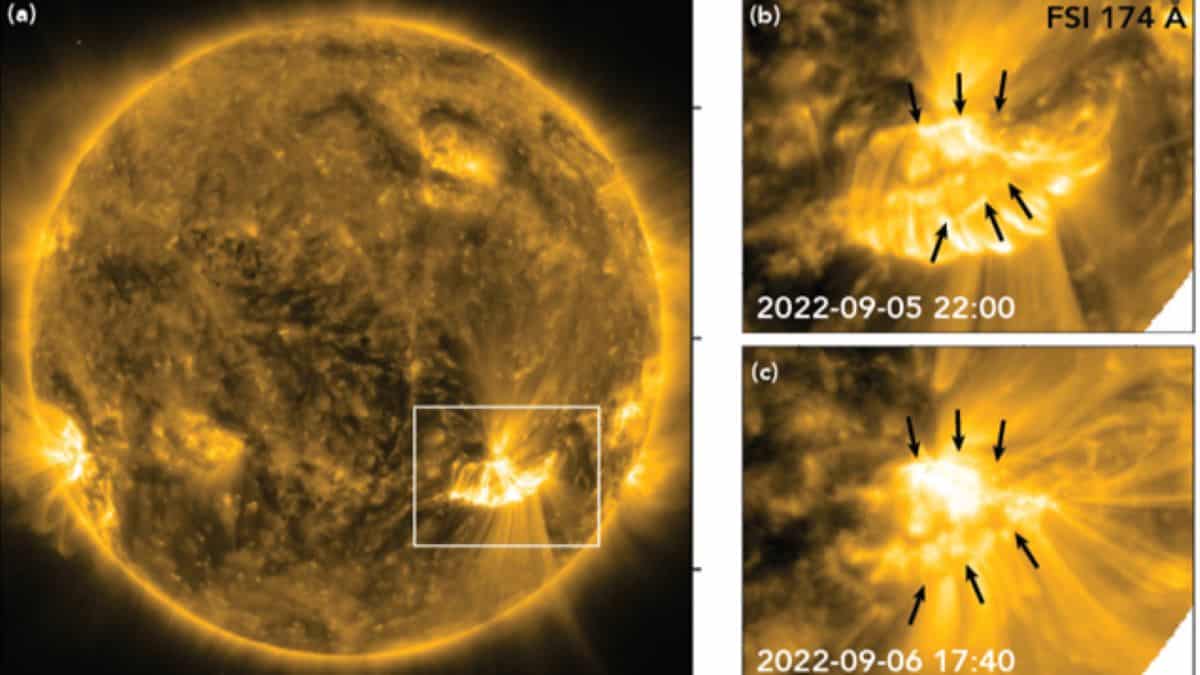
Data captured by NASA’s Parker Solar Probe has confirmed that the Sun’s magnetic field lines break to reconnect in a new configuration, releasing large amounts of energy.
This energy often results in space weather which can affect technology on Earth or in orbit.
Understanding the origins of this space weather may help solar astronomers predict coronal mass ejections, solar flares and other disruptive events, allowing for preparations and redundancies to reduce impacts to technologies like satellites, communications systems and power grids.
Magnetic reconnection was first put forward in the 1950 PhD thesis of British space scientist James Dungey. The theoretical framework was developed in 1956 by English astronomer Peter Sweet and American plasma physicist Eugene Parker – namesake of the Parker Solar Probe. The concept was first published in a 1961 paper by Dungey.
Now the probe’s data has provided the first verification of the magnetic reconnection theory inside the Sun’s corona – the outermost layer of the Sun’s atmosphere, made up of extremely hot plasma.
The findings are detailed in a paper published in Nature Astronomy.
“We’ve been developing the theory of magnetic reconnection for almost 70 years, so we had a basic idea of how different parameters would behave,” says lead author Ritesh Patel from the Southwest Research Institute (SwRI) in the US.
“Since the late 1990s, we have been able to identify reconnection in the solar corona through imaging and spectroscopy. In-situ detection was possible in Earth’s magnetosphere with the launch of missions like NASA’s Magnetospheric Multiscale (MMS) mission. Similar studies in the solar corona, however, only became possible when NASA’s Parker Solar Probe launched in 2018.”

In 2021, the Parker Solar Probe became the first spacecraft to enter the Sun’s corona, offering space scientists new insights into the star at the centre of our solar system.
“Reconnection operates at different spatial and temporal scales, in space plasmas ranging from the Sun to Earth’s magnetosphere to laboratory settings to cosmic scales,” Patel explains.
An approach made by the probe on September 6, 2022, revealed a huge eruption emanating from the Sun. The explosion provided an opportunity to image and sample the plasma in the corona and measure the magnetic field’s properties during such an event for the first time.
Data from instruments onboard the probe as well as observations from the European Space Agency’s Solar Orbiter confirm the probe flew through a reconnection region in the solar atmosphere.
The 2022 magnetic reconnection measurements provide valuable information connecting reconnection events on Earth to those in the Sun’s atmosphere.
“Ongoing work provides discoveries at different scales, which allows us to see how energy is transferred and how particles are accelerated,” Patel says. “Understanding these processes at the Sun can help better predict solar activity and improve our understanding of the near-Earth environment.”